Category Archives: Online Media

Why the local ad opportunity remains unsolved

By Eric Picard (Originally published on AdExchanger.com, September 3, 2013)

Local advertising is the largest pool of dollars in the US advertising industry, but is also by far the most fragmented and complex marketplace.

EMarketer’s numbers below are fascinating. They show clearly that local advertising is massively larger than digital media overall, and while traditional local ad spending, at $109 billion in 2012, seems to be stagnating (I’m not sure I buy that by the way – I’ve seen charts like this before that expect local traditional to stagnate but it hasn’t), that pool of dollars is double the next largest media. This chart expects local digital to double in size by 2017, where it would sit in the same magnitude as the big-league spending areas, including display ads, search and television.

graph1

The problem with local as a category is that it’s a cross-section of every other media, including television, radio, print, digital and a variety of other media types. And the spending is wildly sliced up across many more advertisers than national media. In national media, roughly 9,000 advertisers make up more than 90% of spending across all media. In local, there are millions of businesses spending money. This points to a significant problem scaling spending, especially on the supply side of the market.

Local Advertising Eludes Large Players

Many companies over the years have taken a run at local in the digital space. They range from companies feeding the paid search listings with local business ads to local offers through companies like Groupon and media efforts like Patch that push digital news at the local level while driving ad sales at the national level. There have been hundreds, if not thousands, of companies dashed upon the shores of digital local for every company that’s had some measure of success. This isn’t shocking – startups have spectacular flameout rates – but it is clearly a space with unique hurdles that few have figured it out. Even those we could consider successful, such as Groupon, are widely scrutinized and criticized when it comes to how they’ll scale their business.

There are few models in digital that have scaled across large numbers of media buyers. The rule has been for the most part that other than paid search, there have been only marketplaces that scale on the supply side. Paid search has roughly 500,000 active advertisers participating in the various marketplaces – the main players today are Google and Bing. Google has done a great job of leveraging that advertiser set to apply their combined demand across other marketplaces, but even adSense is a comparatively small pool of spending compared to paid search. So the biggest game in town hasn’t conquered local advertising yet – and they seem far from doing so still, although much closer than in the past.

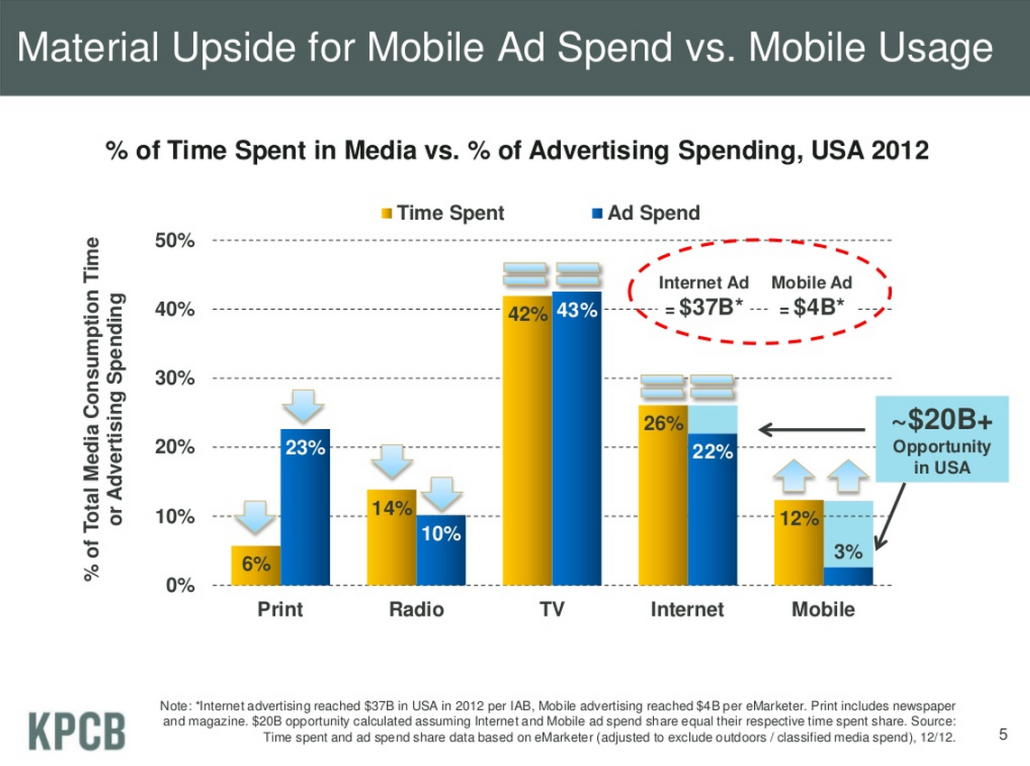
But there is already a huge amount of money spent on local advertising – with millions of participating companies and thousands of competing publishers. It’s a business that’s been in place for hundreds of years, but only in the last decade has it really suffered. In basic media theory we see that where audiences concentrate, media dollars will flow. Generally the theory is that media dollars flow in some proportion to the amount of time spent with those media. And where those things are out of whack, analysts talk about “upside opportunity.” Mary Meeker’s frequently updated deck talks about the disproportionate time spent on digital media vs. the dollars spent as an example of the opportunity in digital (lately she focuses a lot on mobile).
graph2

What I love and hate about this analysis is that while TV has always been a fairly even match against time and dollars spent and, until the last 10 years, radio was similarly matched, there’s always been a strange outlier on this deck. Print media has always looked basically like it does on this chart. This disparity is generally used by analysts to suggest that print media is doomed.

The problem with that analysis is that it’s deeply flawed and doesn’t take into account the reasons why print has such a disparity. When you dig into newspapers, this disparity is even greater. And the more locally you dig in, the greater the disparity – with local newspapers disproportionally getting more dollars than time spent.

The Art Of Selling Media

The reason for this is so simple that it’s rather shocking. My friend Wayne Reuvers, who founded LiveTechnology (a company most have never heard of because it focuses on local traditional media creative production and operates behind the scenes) is the most expert person I know on local media.

One of my favorite quotes of his: “National media is bought, local media is sold.”

What he means is that local advertising dollars are spent mostly by non-professionals, usually someone working within the local business. And as any local business owner will tell you, local media providers trying to sell advertising and marketing opportunities inundate them with sales calls.

National media salespeople generally don’t go out and pitch ad opportunities to media buyers, they respond to RFPs. While there’s plenty of outreach from sell side to buy side, it’s mainly evangelical – making sure the buyers understand what the publisher has to offer, often not a direct business pitch with an expectation of dollars on the line. This is maybe not so true for ad networks, but for publishers it’s generally true.

Newspapers are a category that has been around for hundreds of years, and are the oldest of the local media. The models are mature and extremely efficient. When I’ve talked to local businesses about how they spend advertising dollars and why they spend so much on newspapers compared to the other forms of media, they’ve generally said, “My sales rep at the paper is great, he or she knows me and knows what I need. It’s super easy to execute a buy there, they do almost all the work for me. They’ll even do the creative for me. I just need to pay them money.” Changing the offer or creative in newspaper buys is also easy, so if the buyer needs to focus sales on a loss leader product or have a new promotion, an ad change can be made in a day or two.

Local businesses often find the costs of television spots so high that they can’t be justified. And when they’ve tried to buy display advertising from big publishers, nobody returned their calls. Paid search works well for some businesses, but not so much for others. The only other place where local businesses consistently spend money is on yellow pages. Not surprisingly, this is another place where they are sold ad space constantly with reps who are frequently in touch and educating them on new ways listings are being pushed to digital media.

Reuvers believes that newspapers have dropped the ball in the move to digital. He calls newspapers the first local search engines, and has been so evangelical about their opportunity that he published a manifesto about five years ago to push local newspapers toward a winning model. It is a fascinating read – if a bit out of date – and basically says newspapers should own the space.

Tackling The Local Digital Conundrum

I believe a successful local play for digital dollars must include the following:

1. Local Salespeople

These salespeople should focus on the community and form relationships with local businesses, meaning both small and medium-sized mom-and-pop businesses and local locations or branches of national or regional companies. These national/local companies spend 80% of local ad dollars but have wide discretion about where they spend those dollars. When companies try to run at local with a national sales force, they often fail.

2. Self-Service

Local business owners without a lot of technical skills need streamlined ways to spend dollars in a self-service and lightly assisted way. Scale will come for those who figure out self-service, but finding a way for scalable assisted buying is critical to success.

3. Easy Updating

Local businesses need simple ways to update their advertising or offer based on what works for them. This may take the form of updating the creative message or changing the format. While not deeply analytical on what advertising works, most local businesses are surprisingly astute at understanding what works.

National digital folks tend to discount how well these local businesses understand the effectiveness of their ad dollars. Few local businesses can afford to waste ad dollars, so they are pretty careful about their spending.

That said, they have limited venues to spend money on so they generally can figure it out without much work. Groupon figured out the hard way that local businesses are not stupid about the economics of marketing. There has been a lot of backlash among businesses toward any sense of being taken advantage of, strong-arm tactics or salespeople who don’t understand their business.

Why no one can define “premium” inventory

By Eric Picard (Originally published on iMediaConnection.com on June 17th, 2013)

What is premium inventory? The simple answer is that it’s inventory that the advertiser would be happy to run its advertising on if it could manually review every single publisher and page that the ad was going to appear within.

When buyers make “direct” media buys against specific content, they get access to this level of comfort, meaning that they don’t have to worry about where their media dollars end up being spent. But this doesn’t scale well across more than a few dozen sales relationships.

To address this problem of scale, buyers extend their media buys through ad networks and exchange mechanisms. But in this process, they often lose control over where their ads will run. Theoretically the ad network is acting as a proxy of the buyer in order to support the need for “curation” of the ad experience, but this clearly is not usually the case. Ad networks don’t actually have the technology to handle curation of the advertising experience (i.e., monitoring the quality of the publishers and pages they are placing advertising on) at scale any more than the media buyer does, which leads to frequent problems of low quality inventory on ad networks.

Now apply this issue to the new evolution of real-time bidding and ad exchanges. A major problem with buying on exchanges is that the curation problem gets dropped back in the laps of the buyers across more publishers and pages than they can manually curate, which requires a whole new set of skills and tools. But the skills aren’t there yet, and the problem hasn’t been handled well by the various systems providers. So the agencies build out trading desks where that skillset is supposed to live, but the end results of the quality are highly suspect as we’re seeing from all the recent articles on fraud.

So the true answer to this conundrum of what is premium must be to find scalable mechanisms to ensure that a brand’s quality goals for the inventory it is running advertising against are met.
The market needs to be able to efficiently execute media buys against high-quality inventory at media prices that buyers are comfortable paying — if not happy to pay.

The definition of “high quality” is an interesting problem with which I’ve been struggling. Here’s what I’ve come up with: Every brand has its own point of view on “high quality” because it has its own goals and brand guidelines. A pharma advertiser might want to buy ad inventory on health websites, but it might want to only run on general health content, not content that is condition specific. Or an auto advertiser might want to buy ad inventory on auto-related content, but not on reviews of automobiles.

Most brands obviously want to avoid porn, hate speech, and probably gambling pages — but what about content that is very cluttered with ads or where the page layout is so ugly that ads will look like crap? Or pages that are relatively neutral — meaning not good, but not horrible?

Then we run into a problem that nobody has been willing to bring up broadly, but it’s one that gets talked about all the time privately: Inventory is a combination of publisher, page, and audience.

How are we defining audience today? There’s blended data such as comScore or Nielsen data, which use methodologies that are in some cases vetted by third parties, but relatively loosely. There’s first-party data such as CRM, retargeting, or publisher registration data, which will vary broadly in quality based on many issues but are generally well understood by the buyer and the seller. And there’s third-party data from data companies. But frankly, nobody is rating the quality of this data. Even on a baseline level, there are no neutral parties evaluating the methodology used from a data sciences point of view to validate that the method is defensible. And as importantly, there is no neutral party measuring the accuracy of the data quantitatively (e.g., a data provider says that this user is from a household with an income above $200,000, but how have we proven this to be true?).

When we talk about currency in this space, we accept whatever minimum bar that the industry has laid down as truth via the Media Rating Council, hold our nose, and move forward. But we’ve barely got impression guidelines that the industry is willing to accept, let alone all of these other things like page clutter and accuracy of audience data.

And even more importantly, nobody is looking at all the data (publisher, page, audience) from the point of view of the buyer. And as we discussed above, every buyer — and potentially every campaign for every brand — will view quality very differently. Because the skillset of measuring quality is in direct competition with the goal of getting budgets spent efficiently — or what some might call scale — nobody wants to talk about this problem. After all, if buyers start getting picky about the quality of the inventory on any dimension, the worry is that they might reduce the scale of inventory available to them. The issues are directly in conflict with each other. Brand safety, inventory quality, and related issues should be handled as a separate policy matter from media buying, as the minimum quality bar should not be subject to negotiation based on scale issues. Running ads on low-quality sites is a bad idea from a brand perspective, and that line shouldn’t be crossed just to hit a price or volume number.

So instead we talk about the issue sitting in front of our nose that has gotten some press: fraud. The questions that advertisers are raising about our channels center around this concern. But the advertisers should be asking lots of questions about the broader issue — which is, “How are you making sure that my ads are running on high-quality inventory?” Luckily there are some technologies and services on the market that can help provide quality inventory at scale, and this area of product development is only going to get better over time.

Which Type Of Fraud Have You Been Suckered Into?

By Eric Picard (Originally published by AdExchanger.com on May 30th, 2013)

For the last few years, Mike Shields over at Adweek has done a great job of calling out bad actors in our space.  He’s shined a great big spotlight on the shadowy underbelly of our industry – especially where ad networks and RTB intersect with ad spend.

Many kinds of fraud take place in digital advertising, but two major kinds are significantly affecting the online display space today. (To be clear, these same types of fraud also affect video, mobile and social. I’m just focusing on display because it attracts more spending and it’s considered more mainstream.) I’ll call these “page fraud” and “bot fraud.”

Page Fraud

This type of fraud is perpetrated by publishers who load many different ads onto one page.  Some of the ads are visible, others hidden.  Sometimes they’re even hidden in “layers,” so that many ads are buried on top of each other and only one is visible. Sometimes the ads are hidden within iframes that are set to 1×1 pixel size (so they’re not visible at all). Sometimes they’re simply rendered off the page in hidden frames or layers.

It’s possible that a publisher using an ad unit provided by an ad network could be unaware that the network is doing something unscrupulous – at least at first.  But they are like pizza shops that sell more pizzas than it’s possible to make with the flour they’ve purchased. They may be unaware of the exact nature of the bad behavior but must eventually realize that something funny is going on. In the same way, bad behavior is very clear to publishers who can compare the number of page views they’re getting with the number of ad impressions they’re selling.  So I don’t cut them any slack.

This page fraud, by the way, is not the same thing as “viewability,” which involves below-the-fold ads that never render visibly on the user’s page.  That fraudulent activity is perpetrated by the company that owns the web page on which the ads are supposed to be displayed.  They knowingly do so by either programming their web pages with these fraudulent techniques or using networks that sell fake ad impressions on their web pages.

There are many fraud-detection techniques you can employ to make sure that your campaign isn’t the victim of page fraud. And there are many companies – such as TrustMetrics, Double Verify and Integral Ad Science – that offer technologies and services to detect, stop and avoid this type of fraud. Foiling it requires page crawling as well as advanced statistical analysis.

Bot Fraud

This second type of fraud, which can be perpetrated by a publisher or a network, is a much nastier kind of fraud than page fraud. It requires real-time protection that should ultimately be built into every ad server in the market.

Bot fraud happens when a fraudster builds a software robot (or bot) – or uses an off-the-shelf bot – that mimics the behavior of a real user. Simple bots pretend to be a person but behave in a repetitive way that can be quickly identified as nonhuman; perhaps the bot doesn’t rotate its IP address often and creates either impressions or clicks faster than humanly possible. But the more sophisticated bots are very difficult to differentiate from humans.

Many of these bots are able to mimic human behavior because they’re backed by “botnets” that sit on thousands of computers across the world and take over legitimate users’ machines.  These “zombie” computers then bring up the fraudsters’ bot software behind the scenes on the user’s machine, creating fake ad impressions on a real human’s computer.  (For more information on botnets, read “A Botnet Primer for Advertisers.”) Another approach that some fraudsters take is to “farm out” the bot work to real humans, who typically sit in public cyber cafes in foreign countries and just visit web pages, refreshing and clicking on ads over and over again. These low-tech “botnets” are generally easy to detect because the traffic, while human and “real,” comes from a single IP address and usually from physical locations where the heavy traffic seems improbable – often China, Vietnam, other Asian countries or Eastern Europe.

Many companies have invested a lot of money to stay ahead of bot fraud. Google’s DoubleClick ad servers already do a good job of avoiding these types of bot fraud, as do Atlas and others.

Anecdotally, though, newer ad servers such as the various DSPs seem to be having trouble with this; I’ve heard examples through the grapevine on pretty much all of them, which has been a bit of a black eye for the RTB space. This kind of fraud has been around for a very long time and only gets more sophisticated; new bots are rolled out as quickly as new detection techniques are developed.

The industry should demand that their ad servers take on this problem of bot fraud detection, as it really can only be handled at scale by significant investment – and it should be built right into the core campaign infrastructure across the board. Much like the issues of “visible impressions” and verification that have gotten a lot of play in the industry press, bot fraud is core to the ad-serving infrastructure and requires a solution that uses ad-serving-based technology. The investment is marginal on top of the existing ad-serving investments that already have been made, and all of these features should be offered for free as part of the existing ad-server fees.

Complain to – or request bot-fraud-detection features from – your ad server, DSP, SSP and exchange to make sure they’re prioritizing feature development properly. If you don’t complain, they won’t prioritize this; instead, you’ll get less-critical new features first.

Why Is This Happening?

I’ve actually been asked this a lot, and the question seems to indicate a misunderstanding – as if it were some sort of weird “hacking” being done to punish the ad industry. The answer is much simpler:  money.  Publishers and ad networks make money by selling ads. If they don’t have much traffic, they don’t make much money. With all the demand flowing across networks and exchanges today, much of the traffic is delivered across far more and smaller sites than in the past. This opens up significant opportunities for unscrupulous fraudsters.

Page fraud is clearly aimed at benefiting the publisher but also benefitting the networks. Bot fraud is a little less clear – and I do believe that some publishers who aren’t aware of fraud are getting paid for bot-created ad impressions.  In these cases, the network that owns the impressions has configured the bots to drive up its revenues. But like I said above, publishers have to be almost incompetent not to notice the difference in the number of impressions delivered by a bot-fraud-committing ad network and the numbers provided by third parties like Alexa, Comscore, Nielsen, Compete, Hitwise, Quantcast, Google Analytics, Omniture and others.

Media buyers should be very skeptical when they see reports from ad networks or DSPs showing millions of impressions coming from sites that clearly aren’t likely to have millions of impressions to sell.  And if you’re buying campaigns with any amount of targeting – especially something that should significantly limit available inventory such as Geo or Income– or with frequency caps, you need to be extra skeptical when reviewing your reports, or use a service that does that analysis for you.

Changing The Industry: Don’t Just Complain, Do Something

By Eric Picard (Originally published on AdExchanger – May 6th, 2013)

Take it from me: It’s easy to complain. I’ve been writing monthly articles in this space since 1999, which I think qualifies me as a “semi-professional” complainer. In these articles, I discuss issues facing our industry in a public forum and – sometimes – offer suggestions on how we can fix them. But what gets masked, perhaps, is how problems are really solved behind the scenes in our industry.

I’ve been involved in many industry projects over the years. Some of these projects have come through industry organizations like theInteractive Advertising Bureau, some through my employers, and some through unofficial channels such as informal dinners with industry folks that unexpectedly yield ideas for solutions.

Ultimately, things change when someone is passionate about a topic, decides to do more than just talk about it, and rallies a group of people to make that change happen. More than anything, in my experience, what matters is intent. Pushing forward with the intent to make change happen is what drives change. It sounds simple, but it really is the case.

Recently, I had an experience that illustrates my point. But first, let me set the stage…

In ad technology, most of the company leaders know each other pretty well. Despite Terry Kawaja’s best efforts at showing how complex the “LUMAscape” is, the reality is that we’re a pretty compact industry with a fairly small number of key people.

When it comes to ad technology, there are probably only 100-200 people who’ve been primarily responsible for turning the crank these past 15-20 years – and most of us know each other. Even when we find ourselves competing, we find plenty of respect for each other, as well as – perhaps surprisingly – a lot of consensus on the big issues. When I get in a room with Tom Shields from Yieldex, or Tony Katsur from Maxifier, or John Ramey from isocket, the conversation is always going to be fun because we’re all knowledgeable and passionate about the issues. Even if we don’t talk regularly, we can dive right into these conversations because we can use shorthand. We don’t have to explain any context or background; we all have a baseline of understanding.

So when I started reading my friends’ and colleagues’ articles complaining about something as simple as what we call a new category of digital media, I realized a problem was brewing.

The Great Programmatic Premium Debate

The term “programmatic premium” has taken a life of its own and become confusing to many in the industry. Some folks on the real-time bidding side of the market started using the term to show that ad exchanges were finally getting access to “premium” inventory. But there’s also a whole new category of media tools being used to buy and sell inventory through direct publisher integration. These companies were also using the term “programmatic premium,” but with a whole different set of meanings.

After reading the fifth or sixth article on this topic, I got fed up. I sent an email to all the people who were working in this new space and suggested that we get together and help the industry by deciding what the name should be, developing a position and pushing it to the market. I remembered what happened to the “demand-side platforms” and the “supply-side platforms,” feeling that if we could come to some consensus on ”programmatic premium,” perhaps we could help fix the problem quickly.

I knew that most of the folks involved were likely to attend the AdExchanger Programmatic I/O conference in San Francisco, so I suggested that the group meet at the conference and discuss this. A few weeks ago, this informal industry roundtable – including representatives from eight companies – met during the conference and also gathered input before and after the meeting from others who couldn’t attend in person.

After lengthy debate, we came to a unanimous decision: The best name to describe inventory purchased in an automated way through a buying or selling tool that is directly integrated with a publisher’s ad server is “programmatic direct.”  This name reflects the difference between programmatic real-time bidding (RTB) and the growing category of directly integrated buying and selling tools that enable the replacement of the antiquated request for proposal (RFP) and insertion order (I/O) approach that have been in place since industry began.

Last week, John Ramey from isocket published a summary of the discussion on AdExchanger, to which all the participants added comments. The effort ended in success, and now we can move forward as an industry.

How to Drive Change: Do Something

But this is just one example of many. My point is that the potential to move the industry forward lies in all our hands. We are creating the future of advertising and media – and most people don’t realize the power they hold in that process. Every fire needs a spark to ignite it. It’s from you that real change can come.

There are dozens of examples like the one above, showing how with a little effort, consensus building and leadership, the industry can change.

Another such example is the Universal Ad Package that the IAB pushed through in record time back in 2002. The legend is that this effort started when some folks from Microsoft, Disney and Yahoo got together for drinks at a conference and realized that they could shortcut the whole process of pushing better ad formats through the IAB if they did the legwork ahead of time. They invited several other publishers to the conversation, and before long they had a consensus and a very complete body of work that made the standardization job much easier by the time it arrived at the IAB.

Whether you’re trying to change the name of a category, fix a fundamental problem with the number of standard ad formats, or change the way that some major piece of technology works, don’t shy away from having those conversations. If you don’t like the way a product works, don’t complain to your colleagues. Instead, send an email or pick up the phone and call the person in charge of product management for that product.  You’d be shocked by how few people do this, and how much the product managers want to hear this kind of feedback.

If you are passionate about changing the industry, then do it. Join an IAB committee. Write emails, write articles, have dinner at conferences with like-minded colleagues – and even competitors.  That’s how change happens. That’s how you get things done.

Targeting fundamentals everyone should know


By Eric Picard (Originally published in iMediaConnection, April 11th, 2013)

Targeting data is ubiquitous in online advertising and has become close to “currency” as we think about it in advertising. And I mean currency in the same way that we think about Nielsen ratings in TV or impression counts in digital display. We pay for inventory today in many cases based on a combination of the publisher, the content associated with the impression, and the data associated with a variety of elements. This includes the IP address of the computer (lots of derived data comes from this), the context of the page, various content categories and quality metrics, and — of course — behavioral and other user-based targeting attributes.

But for all the vetting done by buyers of base media attributes, such as the publisher or the page or quality scores, there’s still very little understanding of where targeting data comes from. And even less when it comes to understanding how it should be valued and why. So this article is about just that topic: how targeting data is derived and how you should think about it from a value perspective.

Let’s get the basic stuff out of the way: anything derived from the IP address and user agent. When a browser visits a web page, it spits out a bunch of data to the servers that it accesses. The two key attributes are IP address and user agent. The IP address is a simple one; it’s the number assigned to the user’s computer by the internet to allow that computer to be identified by the various servers it touches. It’s a unique number that allows an immense amount of information to be inferred; the key piece of information inferred is the geography of the user.

There are lots of techniques used here to varying degrees of “granularity.” But we’ll just leave it at the idea that companies have amassed lists of IP addresses assigned to specific geographic locations. It’s pretty accurate in most cases, but there are still scenarios where people are connected to the internet via private networks (such as a corporate VPN) that confuse the world by assigning IP addresses to users in one location when they are actually in another. This was the classic problem with IP address based geography back in the days of dial-up, when most users showed up as part of Reston, Va. (where AOL had its data centers). Today where most users are on broadband, the mapping is much more accurate and comprehensive.

As important as geography are the various mappings that are done against location. Claritas, Prism, and other derived data products make use of geography to map a variety of attributes to the user browsing the page. And these techniques have moved out of traditional media (especially direct-response mailing lists) to digital and are quite useful. The only issue is that the further down the chain of assumptions used to derive attributes, the more muddled things become. Statistically, the data still is relevant, but on a per-user basis it is potentially completely inaccurate. That shouldn’t stop you from using this information, nor should you devalue it — but just be clear that there’s a margin of error here.

User agent is an identifier for the browser itself, which can be used to target users of specific browsers but also to identify non-browser activity that chooses to identify itself. For instance, various web crawlers such as search engines identify themselves to the server delivering a web page, and ad servers know not to count those ad impressions as human. This assumes good behavior on behalf of the programmers, and sometimes “real” user agents are spoofed when the intent is to create fake impressions. Sometimes a malicious ad network or bad actor will do this to create fake traffic to drive revenue.

Crawled data

There’s a whole class of data that’s derived by sending a robot to a web page, crawling through the content on the page, and classifying the content based on all sorts of analysis. This mechanism is how Google, Bing, and other search engines classify the web. Contextual targeting systems like AdSense classify the web pages into keywords that can be matched by ad sales systems. And quality companies, like Trust Metrics and others, scan pages and use hundreds or thousands of criteria to value the rank of the page — everything from ensuring that the page doesn’t contain porn or hate speech to analyzing the amount of white space around images and ads and the number of ads on a page.

User targeting

Beyond the basics of browser, IP, and page content, the world is much less simple. Rather than diving into methodologies and trying to simplify a complex problem, I’ll simply list and summarize the options here:

Registration data: Publishers used to require registration in order to access their content and, in that process, request a bunch of data such as address, demographics, psychographics, and interests. This process fell out of favor for many publishers over the years, but it’s coming back hard. Many folks in our industry are cynical about registration data, using their own experiences and feelings to discount the validity of user registration data. But in reality, this data is highly accurate; even for large portals, it is often higher than 70 percent accurate, and for news sites and smaller publishers, it’s much more accurate.

Interestingly, the use of co-registration through Facebook, Twitter, LinkedIn, and others is making this data much more accurate. One of the most valuable things about registration data is that it creates a permanent link between a user and the publisher that lives beyond the cookie. Subsequently captured data from various sessions is extremely accurate even if the user fudged his or her registration information.

First-party behavioral data: Publishers and advertisers have a great advantage over third parties in that they have a direct relationship with the user. This gives them incredible opportunities to create deeply refined targeting segments based on interest, behavior, and especially from custom created content such as showcases, contests, and other registration information. Once a publisher or advertiser creates a profile of a user, it has the means to track and store very rich targeting data — much richer in theory than a third party could easily create. For instance, you might imagine that Yahoo Finance benefits highly from registered users who track their stock portfolio via the site. Similarly, users searching for autos, travel, and other vertical-specific information create immense targeting value.

Publishers curbed their internal targeting efforts years ago because they found that third-party data companies were buying targeted campaigns on publishers and then their high-cost, high-value targeting data was leaking away to third parties. But the world has shifted again, and publishers and advertisers both are benefiting highly from the data management platforms (DMPs) that are now common on the market. The race toward using first-party cookies as the standard for data collection is further strengthening publishers’ positions. Targeted content categories and contests are another way that publishers and advertisers have a huge advantage over third parties.

Creating custom content or contests with the intent to derive high-value audience data that is extremely vertical or particularly valuable is easy when you have a direct relationship with the user. You might imagine that Amazon has a huge lead in the market when it comes to valuation of users by vertical product interest. Similarly, big publishers can segment users into buckets based on their interest in numerous topics that can be used to extrapolate value.

Third-party data: There are many methods used to track and value users based on third-party cookies (those pesky cookies set by companies that generally don’t have a direct relationship with the user — and which are tracking them across websites). Luckily there are lots of articles out there (including many I’ve written) on how this works. But to quickly summarize: Third-party data companies generally make use of third-party cookies that are triggered on numerous websites across the internet via the use of tracking pixels. These pixels are literally just a 1×1 pixel image (sometimes called a “clear pixel”), or even just a simple no-image JavaScript call from the third-party server, that allows them to set and/or access a cookie that they can set on the users’ browsers. These cookies are extremely useful to data companies in tracking users because the same cookie can be accessed on any website, on any domain, across sessions, and sometimes across years of time.

Unfortunately for the third-party data companies, third-party cookies have recently come under intense scrutiny since Apple’s Safari doesn’t allow them by default and Firefox has announced that it will set new defaults in its next browser version to block third-party cookies. This means that those companies relying exclusively on third-party cookies will see their audience share erode and will need to fall back on other methods of tracking and profiling users. Note that these companies all use anonymous cookies and work hard to be safe and fair in their use of data. But the reality is that this method is becoming harder for companies to use.

By following users across websites, these companies can amass large and comprehensive profiles of users such that advertising can be targeted against them in deep ways and more money can be made from those ad impressions.
Read more at http://www.imediaconnection.com/content/33972.asp#qakIxCXJbl9KpiG3.99

We don’t need no stinkin’ 3rd party cookies!

By Eric Picard (Originally published on AdExchanger.com)

I’ve been writing about some of the ethical issues with “opt-out” third-party tracking for a long time. It’s a practice that makes me extremely uncomfortable, which is not where I started out. You can read my opus on this topic here.

In this article, I want to go into detail about why third-party cookies aren’t needed by the ecosystem, and why doing away with them as a default setting is both acceptable and not nearly as harmful as many are claiming.


First order of business: What is a third-party cookie?

When a user visits a web page, they load a variety of content. Some of this content comes from the domain they’re visiting. (For simplicity sake, let’s call it Publisher.com.) Some comes from third parties that are loading this content onto Publisher.com’s web site. (let’s call it ContentPartner.com.) An example would be that you could visit a site about cooking, and the Food Network could provide some pictures or recipes that the publisher embeds into the page. Those pictures and recipes sit on servers controlled by the content partner and point to that partner’s domain.

When content providers deliver content to a browser, they have the opportunity to set a cookie. When you’re visiting Publisher.com’s page, it can set a first-party cookie because you’re visiting its web domain. In our example above, ContentPartner.com is also delivering content to your browser from within Publisher.com’s page, so the kind of cookie it can deliver is a third-party cookie. There are many legitimate reasons why both parties would drop a cookie on your browser.

If this ended there, we probably wouldn’t have a problem. But this construct – allowing content from multiple domains to be mapped together into one web page, which was really a matter of convenience when the web first was created – is the same mechanism the ad industry uses to drop tracking pixels and ads onto publishers’ web pages.

For example, you might visit Publisher.com and see an ad delivered by AdServer.com. And on every page of that site, you might load tracking pixels delivered by TrackingVendor1.com, TrackingVendor2.com, etc. In this case, only Publisher.com can set a first-party cookie. All the other vendors are setting third-party cookies.

There are many uses for third-party cookies that most people would have no issue with, but some uses of third-party cookies have privacy advocates up in arms. I’ll wave an ugly stick at this issue and just summarize it by saying: Companies that have no direct relationship with the user are tracking that user’s behavior across the entire web, creating profiles on him or her, and profiting off of that user’s behavior without his or her permission.

This column isn’t about whether that issue is ethical or acceptable, because allowing third-party cookies to be active by default is done at the whim of the browser companies. I’ve predicted for about five years that the trend would head toward all browsers blocking them by default. So far Safari (Apple’s browser) doesn’t allow third-party cookies by default, and Mozilla’s Firefox has announced it will block them by default in the next version of Firefox.

Why I don’t think blocking third-party cookies is a problem

There are many scenarios where publishers legitimately need to deliver content from multiple domains. Sometimes several publishers are owned by one company, and they share central resources across those publishers, such as web analytics, ad serving, and content distribution networks (like Akamai). It has been standard practice in many of these cases for publishers to map their vendors against their domain, which by the way allows them to set first-party cookies as well.

How do they accomplish this? They set a ‘subdomain’ that is mapped to the third party’s servers. Here’s an example:

Publisher.com wants to use a web analytics provider but set cookies from its own domain. It creates a subdomain called WebAnalytics.Publisher.com using its Domain Name Server, or DNS. (I won’t get too technical, but DNS is the way that the Internet maps IP addresses – the numeric identifier of servers – to domain names.) It’s honestly as simple as one of the publisher’s IT people opening up a web page that manages their DNS, creating a subdomain name, and mapping it to a specific IP address. And that’s it.

This allows the third-party vendor to place first-party cookies onto the browser of the user visiting Publisher.com. This is a standard practice that is broadly used across the industry, and it’s critically important to the way that the Internet functions. There are many reasons vendors use subdomains, not just to set first-party cookies. For instance, this is standard practice in the web analytics space (except for Google Analytics) and for content delivery networks (CDNs).

So why doesn’t everybody just map subdomains and set first-party cookies?

First, let me say that while it is fairly easy to map a subdomain for the publisher’s IT department, it would be impractical for a demand-side platform (DSP) or other buy-side vendor to go out and have every existing publisher map a subdomain for them. For those focused on first-party data on the advertiser side, they’ll still have access to that data in this world. But for broader data sets, they’ll be picking up their targeting data via the exchange as pushed through by the publisher on the impression itself. For the data management platforms (DMPs), given that this is their primary business, it is a reasonable thing for them to map subdomains for each publisher and advertiser that they work with.

Also, the thing that vendors like about third-party cookies is that by default they work across domains. That means that data companies could set pixels on every publisher’s web site they could convince to place their pixels, and then automatically they would track one cookie across every site they visited. Switching to first-party cookies breaks that broad set of actions across multiple publishers into pockets of activity at the individual publisher level. There is no cheap, convenient way to map one user’s activity across multiple publishers. And only those companies that have a vested interest – the DMPs – will make that investment, and it will limit the number of small vendors who can’t make that investment from participating.

But, is that so bad?

So does moving to first-party cookies break the online advertising industry?

Nope. But it does complicate things. Let me tell you about a broadly used practice in our industry – one that every single data company uses on a regular basis. It’s a practice that gets very little attention today but is pretty ubiquitous. It’s called cookie mapping.

Here’s how it works: Let’s say one vendor has its unique anonymous cookies tracking user behavior and creating big profiles of activity, and it wants to use that data on a different vendor’s servers. In order for this to work, the two vendors need to map together their profiles, finding unique users (anonymously) who are the same user across multiple databases. How this is done is extremely technical, and I’m not going to mangle it by trying to simplify the process. But at a very high level, it’s something like this:

Media Buyer wants to use targeting data on an exchange using a DSP. The DSP enables the buyer to access data from multiple data vendors. The DSP has its own cookies that it sets (today these are third-party cookies) on users when it runs ads. The DSP and the data vendor work with a specialist vendor to map together the DSP’s cookies and the data vendor’s cookies. These cooking mapping specialists (Experian and Acxiom are examples, but others provide this service as well) use a complex set of mechanisms to map together overlapping cookies between the two vendors. They also have privacy auditing processes in place to ensure that this is done in an ethical and safe way to ensure that none of the vendors gets access to personally identifiable data.

Note that this same process is used between advertisers and publishers and their own DMPs so that first-party data from CRM and user registration databases can be mapped to behavioral and other kinds of data.

The trend for data companies in the last few years has been to move into DMP mode, working directly with the advertisers and publishers rather than trying to survive as third-party data providers. This move was intelligent – almost prescient of the change that is happening in the browser space right now.

My short take on this evolution

I feel that this change is both inevitable and positive. It puts more power back in the hands of publishers; it solidifies their value proposition as having a direct relationship with the consumer, and will drive a lot more investment in data management platforms and other big data by publishers. The last few years have seen a data asymmetry problem arise where the buyers had more data available to them than the publishers, and the publishers had no insight into the value of their own audience. They didn’t understand why the buyer was buying their audience. This will fall back into equilibrium in this new world.

Long tail publishers will need to rely on their existing vendors to ensure they can easily map a first-party cookie to a data pool – these solutions need to be baked by companies who cater to long tail publishers, such as ad networks. The networks will need to work with their own DMP and data solutions to ensure that they’re mapping domains together on behalf of their long tail publishers and pushing that targeting data with the inventory into the exchanges. The other option for longer tail publishers is to license their content to larger publishers who can aggregate this content into their sites. It will require some work, which also means ambiguity and stress. But certainly this is not insurmountable.

I also will say that first-party tracking is both ethical and justifiable. Third-party tracking without the user’s permission is ethically a challenging issue, and I’d argue that it’s not in the best interest of our industry to try and perpetuate – especially since there are viable and acceptable alternatives.

That doesn’t mean switching off of third-party cookies is free or easy. But in my opinion, it’s the right way to do this for long-term viability.

What everyone should know about ad serving

By Eric Picard (Originally published in iMediaConnection.com)

Publisher-side ad servers such as DoubleClick for Publishers, Open AdStream, FreeWheel, and others are the most critical components of the ad industry. They’re responsible ultimately for coordination of all the revenue collected by the publisher, and they do an amazing amount of work.

Many people in the industry — especially on the business side of the industry — look at their ad server as mission critical, sort of in the way they look at the electricity provided by their power utility. Critical — but only in that it delivers ads. To ad operations or salespeople, the ad server is most often associated with how they use the user interface — really the workflow they interact with directly. But this is an oversight on their part.

The way that the ad server operates under the surface is actually something everyone in the industry should understand. Only by understanding some of the details of how these systems function can good business decisions be made.

Ad delivery

Ad servers by nature make use of several real-time systems, the most critical being ad delivery. But ad delivery is not a name that adequately describes what those systems do. An ad delivery system is really a decision engine. It reviews an ad impression in the exact moment that it is created (by a user visiting a page), reviews all the information about that impression, and makes the decision about which ad it should deliver. But the real question is this: How does that decision get made?

An impression could be thought of as a molecule made up of atoms. Each atom is an attribute that describes something about that impression. These atomic attributes can be simple media attributes, such as the page location that the ad is imbedded into, the category of content that the page sits within, or the dimensions of the creative. They can be audience attributes such as demographic information taken from the user’s registration data or a third-party data company. They can be complex audience segments provided by a DMP such as “soccer mom” — which is in itself almost a molecular object made up of the attributes of female, parent, children in sports — and of course various other demographic and psychographic atomic attributes.

When taken all together, these attributes define all the possible interpretations of that impression. The delivery engine now must decide (all within a few milliseconds) how to allocate that impression against available line items. This real-time inventory allocation issue is the most critical moment in the life of an impression. Most people in our industry have no understanding of what happens in that moment, which has led to many uninformed business, partnership, and vendor licensing decisions over the years, especially when it comes to operations, inventory management, and yield.

Real-time inventory allocation decides which line items will be matched against an impression. The way these decisions get made reflects the relative importance placed on them by the engineers who wrote the allocation rules. These, of course, are informed by business people who are responsible for yield and revenue, but the reality is that the tuning of allocation against a specific publisher’s needs is not possible in a large shared system. So the rules get tuned as best they can to match the overarching case that most customers face.

Inventory prediction

Well before the impression is generated and has to be allocated out to the impressions in real-time, inventory was sold in advance based on predictions of how much volume would exist in the future. We call these predicted impressions “avails” (for “available to sell”) in our industry, and they’re essentially the basis for how all guaranteed impressions are sold.

We’ll get back to the real-time allocation in a moment, but first let’s talk a bit about avails. The avails calculation done by another component of the ad server, responsible for inventory prediction, is one of the hardest computer science problems facing the industry today. Predicting how much inventory will exist is hard — and extremely complicated.

Imagine if you will that you’ve been asked to predict a different kind of problem than ad serving — perhaps traffic patterns on a state highway system. As you might imagine, predicting how many cars will be on the entire highway next month is probably not very hard to do with a pretty high degree of accuracy. There’s historical data going back years of time, month by month. So you could take a look at the month of April for the last five years, see if there’s any significant variance, and use a bit of somewhat sophisticated math to determine a confidence interval for how many cars will be on the highway in the month of April 2013.

But imagine that you now wanted to zoom into a specific location — let’s say the Golden Gate Bridge. And you wanted to break that prediction down further, let’s say Wednesday, April 3. And let’s say that we wanted to predict not only how many cars would be on the bridge that day, but how many cars with only one passenger. And further, we wanted to know how many of those cars were red and driven by women. And of those red, female-driven cars, how many of them are convertible sports cars? Between 2 and 3 p.m.

Even if you could get some kind of idea how many matches you’ve had in the past, predicting at this level of granularity is very hard. Never mind that there are many outside factors that could affect this; there are short-term issues that could help get more accurate as you get closer in time to the event such as weather and sporting events, and there are much more unpredictable events such as car accidents, earthquakes, etc.

This is essentially the same kind of prediction problem as the avails prediction problem that we face in the online advertising industry. Each time we layer on one bit of data (some defining attribute) onto our inventory definition, we make it harder and harder to predict with any accuracy how many of those impressions will exist. And because we’ve signed up for a guarantee that this inventory will exist, the engineers creating the algorithms that predict how much inventory will exist need to be very conservative on their estimates.

When an ad campaign is booked by an account manager at the publisher, they “pull avails” based on their read of the RFP and media plan and try to find matching inventory. These avails are then reserved in the system (the system puts a hold on avails that are being sent back to the buyer based for a period of time) until the insertion order (I/O) is signed by the buyer. At this moment, a preliminary allocation of predicted avails (impressions that don’t exist yet) is made by a reservation system, which divvies out the avails among the various I/Os. This is another kind of allocation that the ad server does in advance of the campaign actually running live, and it has as much (or even more) impact as the real-time allocation does on overall yield.

How real-time allocation decisions get made

Once a contract has been signed to guarantee that these impressions will in fact be delivered, it’s up to the delivery engine’s allocation system to decide which of the matching impressions to assign to which line items. The primary criteria used to make this decision is how far behind the matching line items are for successfully delivering against their contract, which we call “starvation” (i.e., is the line item starving to death or is it on track to fulfill its obligated impression volume?).

Because the engineers who wrote the avails prediction algorithms were conservative, the system generally has a lot of wiggle room when it comes to delivering against most line items that are not too complex. That means there are usually more impressions available when the impressions are allocated than were predicted ahead of time. So when all the matching line items are not starving, there are other decision criteria that can be used. The clearest one is yield, (i.e., of the available line items to allocate, which one of those lines will get me the most money for this impression?).

Implications of real-time allocation and inventory prediction

There’s a tendency in our industry to think about ad inventory as if it “exists” ahead of time, but as we’ve just seen, an impression is ephemeral. It exists only for a few milliseconds in the brain of a computer that decides what ad to send to the user’s machine. Generally there are many ways that each impression could be fulfilled, and the systems involved have to make millions or billions of decisions every hour.

We tend to think about inventory in terms of premium and remnant, or through a variety of lenses. But the reality is before the inventory is sold or unsold, premium or remnant, or anything else, it gets run through this initial mechanism. In many cases, inventory that is extremely valuable gets allocated to very low CPM impression opportunities or even to remnant because of factors having little to do with what that impression “is.”

There are many vendors in the space, but let’s chat for a moment about two groups of vendors: supply-side platforms (SSPs) and yield management companies.

Yield management firms focus on providing ways for publishers to increase yield on inventory (get more money from the same impressions), and most have different strategies. The two primary companies folks talk to me about these days are Yieldex and Maxifier. Yieldex focuses on the pre-allocation problem — the avails reservations done by account managers as well as the inventory prediction problem. Yieldex also provides a lot of analytics capabilities and is going to factor significantly in the programmatic premium space as well. Maxifier focuses on the real-time allocation problem and finds matches between avails that drive yield up, and it improves matches on other performance metrics like click-through and conversions, as well as any other KPI the publisher tracks, such as viewability or even engagement. Maxifier does this while ensuring that campaigns deliver, since premium campaigns are paid on delivery but measured in many cases on performance. The company is also going to figure heavily into the programmatic premium space, but in a totally different way than Yieldex. In other words, neither company really competes with each other.

Google’s recent release of its dynamic allocation features for the ad exchange (sort of the evolution of the Admeld technology) also plays heavily into real-time allocation and yield decisions. Specifically, the company can compare every impression’s yield opportunity between guaranteed (premium) line items and the response from the DoubleClick Exchange (AdX) to determine on a per-impression basis which will pay the publisher more money. This is very close to what Maxifier does, but Maxifier does this across all SSPs and exchanges involved in the process. Publishers I’ve talked to using all of these technologies have gushed to me about the improvements they’ve seen.

SSPs are another animal altogether. While the yield vendors above are focused on increasing the value of premium inventory and/or maximizing yield between premium and exchange inventory (I think of this as pushing information into the ad server to increase value), the SSPs are given remnant inventory to optimize for yield among all the various venues for clearing remnant inventory. By forcing competition among ad networks, exchanges, and other vehicles, they can drive the price up on remnant inventory.

How to apply this article to your business decisions

I’ve had dozens of conversations with publishers about yield, programmatic premium, SSPs, and other vendors. The most important takeaway I can leave you with is that you should think about premium yield optimization as a totally different track than discussions about remnant inventory.

When it comes to remnant inventory, whoever gets the first “look” at the inventory is likely to provide the highest increase in yield. So when testing remnant options, you have to ensure that you’re testing each one exactly the same way — never beneath each other. Most SSPs and exchanges ultimately provide the same exact demand through slightly different lenses. This means that barring some radical technical superiority — which none have shown me to be the case so far — the decision most likely will come down to ease of integration and ultimately customer service.

Can That Startup Stand Alone, Or Is It Just A Feature?

by Eric Picard (Originally published in AdExchanger 1/24/13)

One of the most common conversations I have on a regular basis about startups, especially in the ad technology space is whether a company has legs. Will they be able to grow large and “go it alone,” or are they really just a feature of a bigger system or platform that hasn’t been added yet? This line of thinking is super important for investors to understand, and a key part of the decision-making process for entrepreneurs as they begin building a company.

Why does this matter?

Investors all have their own set of criteria for how they evaluate investments. Angels and Micro-VCs frequently are willing to invest in companies that are built for a relatively short term flip. They ask, “Can the company build a robust set of features that attract a set of customers in the short term, run at a low burn rate (or even quickly become profitable), integrate with one or more existing platforms, and then get bought within one to three years for a decent return?” In this case, building a company that’s a feature is completely viable and acceptable.

This approach is great if the startup can either bootstrap (not take any money) or just pull in a small amount of investment capital and get profitable (or exit) quickly. For angels and micro-VCs, this kind of investment is great because they can get fantastic returns on a short investment horizon, and sometimes it gets them stock in a larger high flying tech company at a great multiple. Sometimes these will be companies at Series B or C rounds that they couldn’t get into, sometimes they’re large publicly traded companies that the investor gets stock in at a significant market discount.

If the startup is going to need significant capital, it must be able to build a large business that has significant revenues and long sustainable growth. It needs to be able to stand alone for three to six years, and during that time build a large company with an opportunity to exit for greater than $100M – and have a credible story for why they could be worth more than $1B and exit via either an IPO or a significant acquisition.

There have been several examples in the past few years of companies that have been funded as if they were a full standalone company that could build massive revenue and exit big. They’ve taken tens of millions of dollars in funding, and need to either IPO or exit for greater than $100M to be seen as a win by their investors. In these cases, the investors couldn’t properly evaluate if the startup was really a feature or a standalone. So it’s important to have a way to evaluate this in order to avoid making those mistakes – both as an investor and an entrepreneur.

Question 1: Will Google or another big company just add this functionality to its existing product?

Many big companies with significant platform investments will constantly extend their product set over time. Big companies (Google, Microsoft, Yahoo, Amazon, AOL) and the big ad-tech specific companies (AppNexus, Rubicon, Pubmatic, MediaMath, etc.) have large engineering teams, and the reality is that it’s most efficient for large engineering teams to work on large, complex and technically prohibitively problems. They tend to add smaller features on a much slower cycle. That doesn’t mean they won’t add them – it just means they have bigger problems to solve that are higher priority – especially around scale, stability, and redundancy. But eventually they’re going to need to add those features, and they’ll do it either through acquisition or committing resources to build the features. At that point, they’ll be doing what’s known as a “build/buy analysis” to determine where to invest the capital to get the product to their customers. The analysis is going to look something like this:

  1. How many man-hours of development will this take to build?
  2. What’s the cost to develop it in-house, both the actual cost of development and the opportunity cost in both time to market, and the other features that the team won’t be able to work on during the development process?
  3. The answer is likely to come out between $6 and $30 million – with a rare outside answer landing around $50 to $80 million, depending on the complexity of the feature.
  4. That means that for most “feature” companies, exits will be in those ranges, with perhaps a 10 to 20% premium applied. The likelihood of a premium relates directly to how much revenue the company brings with it, minus any costs of both operating the company and integration costs.

This means that startups need to think through a bunch of things if they’re building for acquisition. They should be cheap to buy – ideally in the first range we just discussed. They should be easy to integrate. They should have as few redundant systems and features as possible. They should be architected for scale – to handle the kinds of load that one of those big companies will need to transfer onto their systems post acquisition. But they should be cost effective operationally.

One very smart thing “feature” startups should do as early in their life cycle as possible is integrate with as many of those companies as possible. Thus when that build/buy analysis is done by the acquiring company, the startup is already integrated, is top of mind with the acquirer, and already is familiar with how to develop against their APIs. And in many cases the developers within the startup will already be known by at least some of the developers within the larger company.

Another big question that will come up during due diligence by an acquiring company is whether the startup has any redundant systems that will need to be decommissioned or moved into internal data centers. This is more important than many would realize – especially when it comes to datacenter redundancy. Very few startups have the kind of security and cost efficiencies that a Google, Microsoft or Amazon have in house. So if they’ve invested in their own infrastructure, they’re going to need to move this out of their datacenter and into the bigger company’s infrastructure. Datacenter contracts should be crafted to facilitate this – and hardware is probably just a loss. Building in the cloud can solve this in some cases, but in others, might cause problems of their own – e.g. any real time systems built in the cloud are highly unlikely to scale to cover the needs of a big company. Architecting for scale, even if the startup doesn’t scale up right away, is a critical consideration.

Question 2: How do we define a “standalone” business, and what justifies the higher acquisition costs?

First and foremost consideration in this case is revenue. Companies with deep customer relationships and lots of revenue can both run standalone, and/or be acquired for a large amount of money at significant multiples. Think of a few companies that have been acquired on that scale: AdMeld built a real and significant business that had deep customer relationships, real revenue, and was acquired by Google for a significant premium at a high price. Same goes for Invite Media and DoubleClick, both bought by Google; aQuantive, bought by Microsoft; and Right Media, bought by Yahoo.

All of these companies built significant businesses, with large numbers of customers, decent margins, and were not bought for their technology. In each of those cases, the core technology of each company was completely re-architected and redeveloped by the acquirer (in aQuantive’s case, a little less so).

So when starting a company, and when evaluating that company for investment, one must consider how much revenue, and how many customer relationships, the company can effectively build over a three to six year period. If the answer to both questions is “lots,” and a credible case can be made – then consideration for this kind of investment (both in time/effort from the entrepreneur and cash from the investors) is justified.

Other considerations for whether the business will stand the test of time:

How “sticky” will those relationships be? Ad serving is the penultimate example of a sticky ad technology. It’s so complex and cost prohibitive to switch out your ad server – either for publishers or agencies – that it almost never happens. That’s one reason ad servers with lots of traction were bought for such huge premiums, even though there was significant price compression over time. If the technology is sticky because of integrations into either infrastructure or business processes, it’s a good candidate to be a standalone.

Does the company sell a product, service or commodity that has transfer-pricing pressure?

Or, does the company either create the product it sells from scratch or process the product of another company in a way that adds significant value? Ideally in the latter scenario it would do this in a way that is difficult to replicate – for example, by analyzing big data with some unique and differentiated methods in order to add intelligence and value to what it sells.

Transfer pricing pressure is critical to understand: The best current example of transfer pricing pressure is music. Any business that has started in the music space has been doomed to either incredibly poor margins or instability. This is because the music companies can simply increase the costs of the final good being sold (songs or albums) any time they please. As soon as one of the companies selling music digitally begins to get profitable, the music industry can throttle their margins by increasing price. In the advertising space this is similar to a problem early ad networks had – the ad rep firms. Because the ad rep firms didn’t own the inventory they sold, and re-sold the product of the publisher directly with no additional value, they were doomed to low multiple exits and low valuations if they managed to get large enough to IPO.

A recent example of transformation in a category that shows how some of these standalone companies have become more resilient is the data companies. They started out with relatively undifferentiated mechanisms to create targeting segments that led to the creation of ad networks, then were integrated with data marketplaces on the exchanges, and now have transformed themselves into Data Management Platforms. Lotame is a great example of a company that has made this transition – but many others have as well.

By applying this type of analysis to opportunities to create a company or invest in a company, entrepreneurs and investors can make smart decisions about what to build, and what to invest in.

What the heck does “programmatic” mean?

By Eric Picard (originally published on iMediaConnection.com 1/10/13)

This article is about programmatic media buying and selling, which I would define as any method of buying or selling media that enables a buyer to complete a media buy and have it go live, all without human intervention from a seller.

Programmatic is a superset of exchange, RTB, auction, and other types of automated media buying and selling that have mainly been proven out for remnant ad inventory clearing mechanisms up until today. So while an auction might or might not be involved in programmatic buying and selling, the roots and infrastructure behind the new programmatic world is based on the same infrastructure that the ad exchanges, DSPs, SSPs, and ad servers have been plumbing and re-plumbing over the last five years.

Let’s talk first about so-called “programmatic premium” inventory, as this is what I’m seeing as the most confusing thing in the market today. Many people still think of programmatic media as remnant inventory sold using real-time bidding. But that’s far from the whole truth today. All display media could (mechanically) be bought and sold programmatically today — whether via RTB or not, whether it’s guaranteed or not, and whether it’s “premium” or not. Eventually all advertising across all media will be bought and sold programmatically. Sometimes it will be bought with a guarantee, sometimes it won’t.

What we’re talking about is how the campaigns get flighted and how ad inventory is allocated against a specific advertiser’s campaign. In premium display advertising, this is done today by humans using tools, mostly on the publisher side of the market. In the programmatic world, all buys — even the up-front buys — will be executed programmatically. So when I say that all ads will be bought and sold programmatically, I mean that literally. If Coke spends $50 million with Disney at an upfront event, that $50 million will still be executed programmatically throughout the life of that buy. The insertion order and RFP process goes away (as we know it) and is replaced by a much more efficient set of processes.

In this new world, sales teams don’t go away. They become more focused on the value that they can add most effectively. That’s in the relationship and evangelism of their properties and the unique content and brand-safe environment that they bring to the table. Sales teams will also engage in broader, more valuable negotiations with buyers — doing more business development and no “order taking.”

In a programmatic world, prices and a whole slew of terms can be negotiated in advance. Essentially what’s happening is that the order-taking process, the RFP, and the inventory avail “look up” that have been intensely manual for the past 20 years are being automated. And APIs between systems have opened up that allow all these various tools to communicate directly and to drive through the existing roadblocks.

Here are five things everyone in our industry should know about programmatic media buying and selling.

It’s inevitable

Programmatic buying and selling is coming, is coming big, and will change the way people buy and sell nearly all media — across all media types — over the next five to 10 years. This will be the case in online display over the next two to three years.

It’s comprehensive

Programmatic is not just RTB, is not just “bidding,” and is not one channel of sales. It’s comprehensive, it’s everything that will be bought and sold, and it’s all forms of media across all sales channels. That’s why I’m hedging by saying five to 10 years, as it will take more than five years to do all these things across all media. But certainly fewer than 10. And a lot is transitioning over the next two years, especially online.

Prices will still vary

In non-programmatic buying and selling (old-fashioned traditional relationship sales), different customers are charged different prices all the time for exactly the same product. That doesn’t go away. Different advertisers get different prices for all sorts of reasons. In the worst case, the buyers might be worse negotiators. But it could be that the advertisers spend more than $1 million monthly with that publisher and therefore get a huge discount on CPM. There are all sorts of reasons that this happens. The same exact thing will happen programmatically. Various advertisers will have hard-coded discounts that are negotiated by humans in advance. Price will drop as thresholds on overall spend are hit. Prestigious brands will get preferences that crappy or unknown brands don’t get. This can all be accommodated right now — this very minute — in almost every major system out there. It’s here. Now.

Complexities will remain

All the various “ad platforms” of the past and the new true ad platforms of today have opened up APIs and can communicate with each other programmatically. This is the way the infrastructure is powering programmatic buying and selling. I can’t stress to all of you how fundamental this change is. It’s not about bidding, auctions, futures, hedges, etc. — although those things will certainly exist and proliferate. It’s about automating the buying and selling process, removing friction from the market, and providing immense increases in value across the board. People talk about how complex the LUMAscape map of ad tech vendors is, but what they miss is that there’s plenty of room for lots of players when they can all easily connect and interact. I do believe we’ll see consolidation — mainly because there’s too little differentiation in the space (lots of copycat companies trying to compete with each other). But I do believe that the ecosystem can afford to be complex.

TV comparisons do not apply

People keep using the television upfronts as the analog to online premium inventory, and the television scatter market as the analog of remnant inventory. That’s not the right metaphor; they’re not equivalent. And even TV will move to programmatic buying and selling in the next decade. But let me lay this old saw to rest once and for all:

  • In television, the up-front is a discount mechanism. Buyers commit to certain spend in order to get a discount. Publishers use the upfront as a hedge in order to mitigate later-term risk by the seller that they will not sell out their inventories.
  • The scatter market is still the equivalent of guaranteed inventory online (although it’s more “reserved” than guaranteed). It’s just sold closer to the date of the inventory going live. I’d argue that with the exception of the random “upfronts” run by some publishers online today, all online premium ad sales is the equivalent of the television scatter market.
  • Remnant is a wholly other thing in television — and isn’t part of the scatter market. TV limits remnant significantly (in healthy economies to about 10 percent of total inventory). We’ve mucked that all up online by selling every impression at any price, which has lowered overall yield and flooded the market with cheap inventory — most of which is worthless.

Time for a New Mobile Ad Format

By Eric Picard (Originally published on AdExchanger.com 11/19/12)

I’ve been designing, prototyping and deploying new ad formats in digital advertising for more than 15 years. I started one of the first rich media advertising companies, where we pioneered many of the ad formats that today are standard offerings – starting in late 1997.  And I ran a team at Microsoft that focused on building new ad unit prototypes for emerging media for several years, which created hundreds of prototypes that were shown to dozens of brands and creative agencies for feedback, and we ran many studies.

I tell you all this not to toot my own horn, but to explain that when I suggest that I’m going to propose a new ad format for the mobile industry, I’m not doing so idly.  I’ve been doing this professionally for my entire career, and the problem of putting new ad formats on devices is one that I’ve thought an awful lot about.  In fact, the format I’m going to suggest is very similar to one I proposed for another new device that was an innovative music and media player.  But I’ll hold off on the specifics for a bit.

The biggest problem with mobile advertising today is the ad formats being deployed. The screen is very small, and even a very small ad unit that isn’t well integrated into the screen experience of an app or mobile website causes a dissonance that is simply unacceptable to most users.  And app developers see this clearly – using the presence of ads not really to drive ad revenue, but rather to annoy the crap out of consumers in order to push them to pay for the premium version of an app.  This is a very backwards approach to advertising experience, but one that has been used repeatedly over the course of digital evolution.

Ad experience design is a very tricky problem – because ad experiences need to walk the razor’s edge between grabbing the audience’s attention while not pushing them over into frustration.  For this reason, in many ways, ad experience design is far harder than standard user experience design for applications.  Unfortunately the vast majority of startups and even large companies that deploy apps and mobile sites simply slap tiny mobile banners onto their applications, and wait for the dollars to roll in. That isn’t likely to happen for most companies, because the ad experience is horrible.

So I decided that instead of simply complaining about the ad experience of mobile, I’d propose to the industry through this article a new ad format that I believe will fix the core problems with mobile ads. I hope somebody picks it up and runs with it, because I firmly believe (after many years of thinking about these problems) that it’s the right solution for mobile. And I believe the same principles behind the format I’m suggesting would work well for tablets.

Let me start by saying something perhaps a little controversial – it’s impossible for companies to differentiate from each other by using proprietary ad formats.  Note that all rich media companies offer essentially the same ad formats.  And this is one reason I’m not bullish on the current so-called “native ad format” movement.  Unless you’ve got the reach of Google, Twitter or Facebook, rolling your own ad format is stupid.  Advertising’s core principle is about reach – advertisers try to reach as broad an audience as possible that matches their target customer persona. Creative teams can’t cost effectively create unique ad formats for every publisher. This means that once a proprietary format starts getting scale, other companies copy that format and they begin to perpetuate. But we’ve only seen this happen with “native” formats when the company that created the format had large scale.  So all paid search ads pivot off Google’s format, because the same creative needs to be uniform across search engines. And when formats that were pioneered by one rich media company got traction, every other rich media company adopted those formats too.  Ad formats don’t work as product differentiators.

So what will work?

First:  The format must be integrated into the design of the application (app or web).

App and M-Web developers must build their user experience *around* the ad vehicle. So the ad vehicle can’t be crappy – it needs to fit neatly into a standard App experience. It needs to provide utility to the advertiser (enable attention to be captured, and ideally to drive activity) and it needs to nestle carefully into the utility of the application it sits in.

Second: The screen is small, so the ad needs to use the whole screen.

Interstitial advertising has been around since the early days of the web – Unicast promoted the format broadly with its Superstitial format, which then was copied by all the other companies.  But most of us who use mobile apps will probably agree that a straightforward interstitial experience is incredibly disruptive and annoying.  So putting up a full screen ad that a user has to stare at before accessing their content is simply unacceptable. What’s the answer?

Way back in 2006 I wrote an article that discussed the (then) current trend toward trying to drop short 5 second videos at the end of pods of content on television to combat fast forwarding on DVRs.  We did some research back at the time at Microsoft that showed that consumers got annoyed with advertising content about 5 seconds into the roll of a video.  We surmised at the time that for non-video content, a few seconds of static “sponsorship text” would be a good way to introduce pre-roll videos – that placing a short sponsorship message in front of the ads would soften the transition – especially if it was limited to a couple of seconds.  We’ve seen this deployed to great effect at Hulu.

I believe the answer is simple: Create a multi-part ad format that has different stages and experiences.

First it’s a full screen ad unit with basic sponsorship text: This app is proudly sponsored by “insert advertiser name here.”  Maybe the company logo can go on this screen as well. At the bottom of the full screen sponsorship, in small text, a message states: To see more, swipe the ad.

Then the full screen unit should shrink down to a “leave-behind” banner that needs to be persistent, needs to be small, and needs to be “swipeable”.  The leave-behind needs to take up the entire bottom of the screen – from left-to-right side.  The creative content in this banner may not take up the entire screen width, but can be centered in the ad unit ‘space’ and ideally the background color of the ad should be matched by the background on the two edges of the ad unit (this is technically easy to do in apps) such that it doesn’t ‘hover’ in the middle of the screen. It’s also important that the same is done with the first and second interstitials – they should cover the whole screen, and be centered in the screen – not locked “off center” to the upper left-hand corner.

The banner should have no more than three to five message transitions (animation points) that can tell an enticing message to the user to facilitate them swiping the ad.  That should be followed by a short “swipe here” animation that is instructional for users to see that they need to swipe the ad to open a bigger ad experience.

Upon swiping the ad unit, a full-screen ad should expand out of the banner unit that is fully interactive and immersive. This can be a “mini-game” experience, a video, an interactive unit that enables commerce or opting into something (a Facebook Like, tweeting a message to your friends, etc).  It should not open a mobile web browsing experience that bounces the user out of the App experience, because once a user is trained that doing anything in the ad is going to bounce them away from their game, they’ll never interact with another ad.

For Apps that have natural transition points (e.g. Moving from level-to-level in a game, or similar), the ad unit can expand out for no more than 5 seconds, and if the user chooses to interact with it – can stay up until the user closes it.

The ad transitions are extremely important to get right.  The initial interstitial unit should smoothly slide down off the screen leaving the banner unit there. The expansion of the banner to take over the whole screen also should be extremely smooth and feel “well crafted” to the audience. Also the initial interstitial should only be shown once per session to avoid annoying the audience. This won’t preclude multiple ads or advertisers per session – but will create scarcity and value to the session sponsor.

The other critical issue here is transition timing.  The initial ad experience needs to be no more than 3 seconds.  The animation frames of the leave-behind banner need to last no more than 7 to 10 seconds. Any automated expansion of the ad unit should leave the expanded page up for no more than 5 seconds.

I believe that if this ad unit were deployed uniformly across apps and mobile web experiences, the industry would see CPMs increase significantly, and the mobile advertising space could enjoy an interesting renaissance. I’m sure there are other answers to this problem – other formats for instance – that would work equally well, or even better.  But if the industry doesn’t lock to a standard format quickly – I fear that the space will continue to languish and won’t see the growth it deserves.

As I said above, ad formats don’t work as product differentiators.  But the largest players do have the ability to use their reach as a driver of format adoption – which is good for the industry. Apple, Google and Microsoft should work together here to drive adoption of a great uniform ad unit that can work across mobile devices.

Follow Eric Picard (@ericpicard) on Twitter.